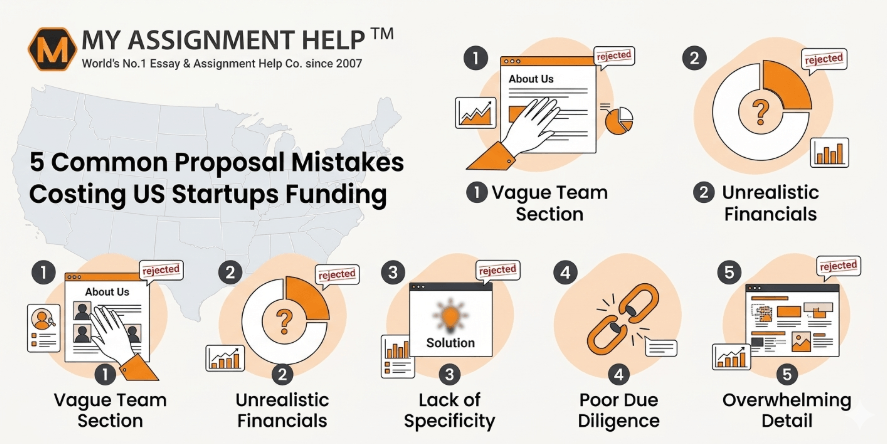
For American startups, the distance between a “seed round” and a “dead end” is often measured by the quality of a single document: the business proposal. In a cooling venture capital market where “dry powder” is being guarded more closely than ever, the margin for error has shrunk to near zero.
According to recent data from Crunchbase, while US startup funding saw a slight stabilization in early 2026, investors have shifted their focus from “growth at all costs” to “resilience and clarity.” Despite this, thousands of founders continue to see their pitches rejected—not because their ideas lack merit, but because their proposals fail to communicate value effectively.
Securing capital requires more than a visionary idea; it demands a structured, data-backed narrative that aligns with institutional expectations. Many founders find that outsourcing the structural heavy lifting to professional business proposal writing services allows them to focus on product-market fit while ensuring their documentation meets the rigorous standards of Silicon Valley or Wall Street analysts.
1. The “Vision Vacuum”: Failing to Quantify Product-Market Fit
The most frequent mistake US startups make is leaning too heavily on “visionary” language while neglecting hard data. Investors in the US market are increasingly skeptical of anecdotal evidence. A proposal that claims a “massive market opportunity” without citing specific Bottom-Up TAM (Total Addressable Market) calculations is often discarded immediately.
The Fix: Use the “Logic-to-Landscape” approach. Instead of stating the market is big, show the specific segment you are capturing.
- Source: A 2025 report by the National Venture Capital Association (NVCA) highlighted that 42% of startups fail because there was no “market need” demonstrated in their initial pitch.
- Strategy: Include a Competitor Comparison Matrix that highlights a specific gap in the current US landscape, backed by consumer behavior data from platforms like Statista or Gartner.
2. Ambiguous Financial Projections and “Burn Rate” Ignorance
In the current economic climate, US investors are hyper-focused on the path to profitability. A common mistake is presenting a “hockey stick” growth curve without explaining the underlying unit economics. If your proposal doesn’t clearly outline your Customer Acquisition Cost (CAC) vs. Lifetime Value (LTV), it signals a lack of financial literacy.
The Fix: Present a 3-to-5-year financial forecast that includes a “Best Case,” “Base Case,” and “Conservative” scenario. Highlighting your “Burn Rate” and “Runway” shows the investor exactly how long their capital will last. If you are a student-founder balancing academic rigors with a startup launch, you might seek professional support and ask someone to do my college assignment for me to clear the necessary time for deep-dive financial modeling.
3. Ignoring the “Founder-Market Fit” Narrative
Investors don’t just fund ideas; they fund people. A proposal that focuses 100% on the product and 0% on why this specific team is uniquely qualified to solve the problem is a losing proposal. In the US, the “Why You?” is just as important as the “What?”.
The Fix: Include a “Human Capital” section. Showcase the technical expertise, previous exit history, or unique lived experiences of the founding team.
- Data Point: Harvard Business Review research suggests that “Founder-Market Fit” is one of the top three predictors of venture success.
4. Over-Complicating the Value Proposition
The “Elevator Pitch” rule applies to written proposals too. If an associate at a VC firm cannot understand your core value proposition within the first 30 seconds of reading the executive summary, the rest of the 40-page document won’t matter. Over-using technical jargon or “buzzword soup” (AI-driven, blockchain-integrated, synergistic paradigms) acts as a red flag for lack of clarity.
The Fix: Use the “Grandma Test”—if you can’t explain your business model to a non-technical person in two sentences, simplify it. Use clear, active US English and avoid “fluff” adjectives.
5. Lack of a Clear “Use of Funds” Breakdown
Many startups ask for $2 million but fail to explain exactly where that money goes. Saying “Marketing and R&D” is too vague. Investors want to see a granular breakdown: “30% for hiring 4 Full-Stack Engineers, 20% for GTM strategy in the Tri-State area, 50% for product beta testing.”
The Fix: Create a “Capital Allocation Pie Chart.” This visualizes your strategic priorities and proves that you have a roadmap for their investment.
See also: Healthcare Data and AI Integration
Key Takeaways for US Founders
- Data is King: Never make a claim you can’t back with a 2024-2026 citation.
- Clarity over Complexity: High-level investors value brevity and directness.
- Financial Transparency: Know your CAC, LTV, and Burn Rate inside out.
- Team Authority: Prove that your team has the E-E-A-T (Experience, Expertise, Authoritativeness, and Trustworthiness) to execute.
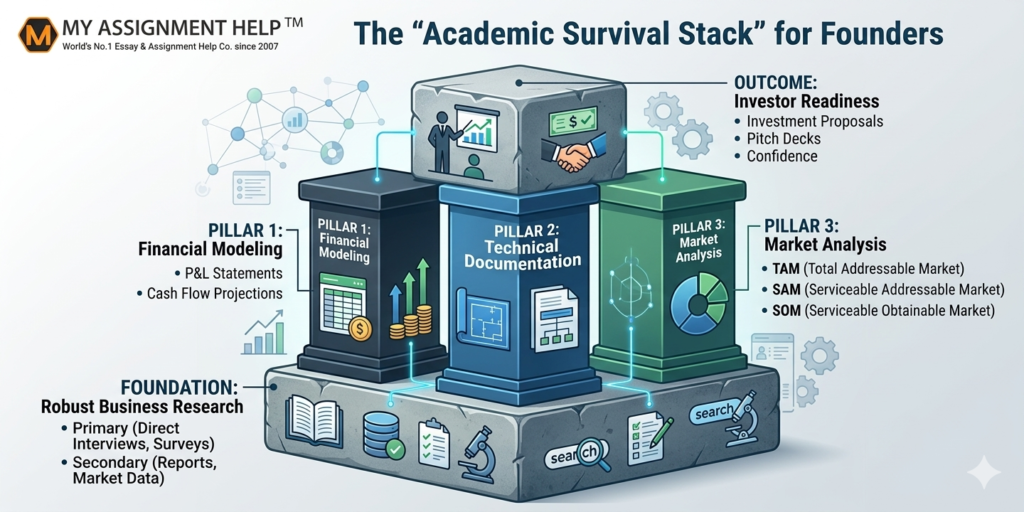
FAQs
Q: How long should a formal business proposal be for a US startup?
A: While pitch decks are short (10–15 slides), a full written proposal for due diligence usually ranges between 20 to 50 pages, including appendices and financial tables.
Q: Should I include a non-disclosure agreement (NDA) with my proposal?
A: Generally, no. Most US VCs have a policy against signing NDAs at the initial stage. Focus on protecting your “secret sauce” while sharing enough to prove value.
Q: What is the most important financial metric for 2026 investors?
A: “Efficient Growth.” Investors are looking for a high LTV/CAC ratio, signaling that your business can grow without burning through cash at an unsustainable rate.
About the Author
James Sterling Senior Content Strategist at MyAssignmentHelp James Sterling is a veteran business consultant and senior writer with over 12 years of experience in the US startup ecosystem. Specializing in venture capital documentation and strategic SEO, James has helped dozens of firms refine their E-E-A-T signals to attract institutional investment. He currently leads the professional writing division at MyAssignmentHelp, focusing on bridging the gap between academic theory and real-world market execution.
References & Sources
- National Venture Capital Association (NVCA): 2025 Yearbook on US Investment Trends.
- Crunchbase News: Q1 2026 Venture Report: The Shift Toward Resilience.
- Harvard Business Review: The Importance of Founder-Market Fit in Early-Stage Funding.
- Statista: Projected Growth of Tech Startups in North America (2024-2028).
