
Writing a political philosophy essay in the current academic and social climate requires more than just an understanding of historical texts. It demands the ability to bridge the gap between abstract normative theory and the complexities of modern governance, digital ethics, and global justice. Whether you are analyzing Rawls’s Theory of Justice or debating the merits of digital sovereignty, a compelling essay must demonstrate rigorous logic, deep textual engagement, and a keen awareness of contemporary applications.
In an era defined by polarized discourse, the challenge for students is to remain objective yet incisive. A high-quality essay doesn’t just summarize a philosopher’s view; it interrogates the underlying assumptions and tests them against the realities of the 21st century.
The Pillars of Political Philosophy
To excel in this field, one must master three core pillars: Interpretation, Evaluation, and Application. You must first accurately represent a thinker’s position, then critically assess its internal consistency, and finally determine its relevance to modern political problems.
Navigating these complex theoretical frameworks often requires specialized guidance to ensure your arguments meet high academic standards. Many students find that consulting a philosophy essay writing service can provide the structural clarity needed to organize dense philosophical concepts. By utilizing resources like myassignmenthelp, writers can gain insights into how to frame their thesis within the broader “Great Conversation” of political thought.
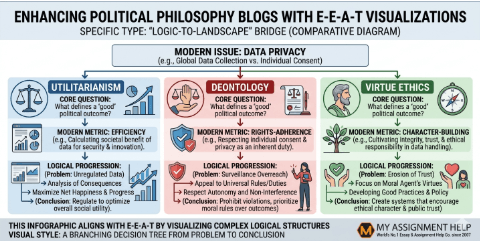
1. Defining Your Normative Framework
Political philosophy is inherently normative—it deals with how things ought to be, rather than just how they are. Your first step is to identify the central value you are defending. Are you arguing from a position of Utilitarianism, Deontology, or Virtue Ethics?
A successful essay establishes this framework early, allowing the reader to follow the logical “skeleton” of your argument. Without a clear normative starting point, your analysis risks becoming a series of disconnected opinions rather than a cohesive philosophical defense.
2. Crafting a Resilient Thesis Statement
A compelling thesis in political philosophy must be “contestable.” If no reasonable person would disagree with your statement, it is not a thesis—it is a fact.
- Weak: “John Locke believed in natural rights.” (Descriptive)
- Strong: “While Locke’s theory of natural rights provided the foundation for modern liberalism, his ‘proviso’ on property acquisition fails to account for the resource scarcity inherent in digital economies.” (Argumentative)
See also: Accepting Crypto Payments in Your Business
3. Engagement with Primary and Secondary Sources
Modern political philosophy is a dialogue. You must engage directly with primary texts (Plato, Hobbes, Mill, Arendt) while situating your argument within contemporary scholarship.
- Primary Sources: Show you can handle the original logic.
- Secondary Sources: Show you understand the current “state of the art” in the field.
| Analytical Component | Purpose in the Essay |
| Logic | Validating the deductive or inductive strength of the argument. |
| Context | Understanding the historical “why” behind a philosopher’s stance. |
| Counter-Argument | Addressing the strongest version of your opponent’s view (The Steel Man). |
4. Addressing the “So What?” (Contemporary Relevance)
Today’s best essays connect theory to modern dilemmas. For instance, how does Social Contract Theory apply to User End Agreements? Or what does distributive justice say about Universal Basic Income (UBI)?
Given the rigorous nature of these assignments and the depth of research required, many students feel the pressure of tight deadlines and high expectations. In such cases, it can be a strategic move to pay someone to write an essay for you who has mastered these academic nuances. Professional assistance ensures that your exploration of democratic theory or the paradox of tolerance is handled with the appropriate level of scholarly sophistication.
Key Takeaways
- Focus on Normative Claims: Always argue for an “ought” based on logical foundations.
- Steel Man the Opposition: Always address the most sophisticated version of the counter-argument to build credibility.
- Clarity over Complexity: Use precise language. Avoid “philosophical jargon” unless it is necessary and defined.
- Connect to Reality: Use modern examples (e.g., climate change, AI ethics) to prove the theory’s utility.
FAQ Section
Q: How do I avoid being biased in a political philosophy essay?
A: Bias is avoided through “internal critique.” Instead of saying a philosopher is “wrong” because you disagree, show where their logic fails based on their own premises.
Q: What is the best way to cite philosophical texts?
A: Most philosophy departments prefer Chicago or APA style. When citing classic works like Plato’s Republic, use Stephanus numbers (e.g., 327a) so readers can find the passage in any translation.
Q: Can I use “I” in my essay?
A: In US academic standards, “I argue that…” is often acceptable to denote your original contribution, but check your specific rubric. Generally, the strength of the logic should speak for itself.
Author Biography: Dr. Aris Thorne
Senior Academic Consultant at MyAssignmentHelp
Dr. Aris Thorne holds a PhD in Political Theory with a focus on Enlightenment philosophy and modern democratic erosion. With over 10 years of experience in academic writing and SEO content strategy, Dr. Thorne specializes in helping students bridge the gap between complex theoretical frameworks and high-scoring essay structures.
References
- Rawls, J. (1971). A Theory of Justice. Harvard University Press.
- Nozick, R. (1974). Anarchy, State, and Utopia. Basic Books.
- Young, I. M. (1990). Justice and the Politics of Difference. Princeton University Press.
- Pettit, P. (1997). Republicanism: A Theory of Freedom and Government. Oxford University Press.
